Most businesses treat SEO like a boiler repair: pay once, fix it, forget it. Then rankings slip, a competitor overtakes them, and the phone goes quiet. The benefits of monthly SEO come from the opposite approach: steady, compounding work that protects what you have built and keeps adding to it. This guide covers what you actually get for a monthly retainer, what it costs, and when it is genuinely worth paying for.
What Are the Benefits of Monthly SEO?
Monthly SEO gives you compounding organic traffic, protection against algorithm updates, and rankings that hold instead of fading. Because the work never stops, each month builds on the last: more content indexed, more links earned, more problems fixed before they cost you visibility. The main benefits are:
-
Organic traffic that compounds month after month
-
Protection when Google updates its algorithm
-
Content that builds topical authority over time
-
Technical problems caught before they hurt rankings
-
A widening gap between you and competitors
-
Stronger local visibility
-
Lower cost per lead than paid ads over time
-
Accountability through monthly reporting
-
Visibility in AI search results, not just blue links
-
Growth you keep, rather than rankings that fade
What Is Monthly SEO?
Monthly SEO is search engine optimisation delivered as an ongoing service rather than a single project. Each month, a provider works through a planned cycle: content creation and updates, technical fixes, link building, keyword tracking and reporting.
A one-off project gives your website a tune-up. Monthly SEO services treat it as a living asset. Google’s results change constantly, your competitors keep publishing, and searcher behaviour shifts. Ongoing work is how you keep pace with all three.
It is also how most of the industry operates. In an Ahrefs survey of 439 SEO providers, 78.2% said they charge through a monthly retainer, well ahead of per-project pricing (48.9%) and hourly rates (34.8%).
10 Benefits of Monthly SEO Services
Here are the ten benefits that matter most, and the mechanism behind each one.
1. Organic traffic that compounds
Rankings behave like interest: small monthly gains stack. A page that climbs from position eight to position four keeps earning extra clicks every day after the move, and the next month’s work starts from that higher base.
The maths behind position is brutal. Backlinko analysed roughly 4 million search results and found the #1 organic result takes 27.6% of all clicks, the top three take 54.4% combined, and the whole of page two shares just 0.63%. Monthly work is what moves you up that curve, one position at a time.
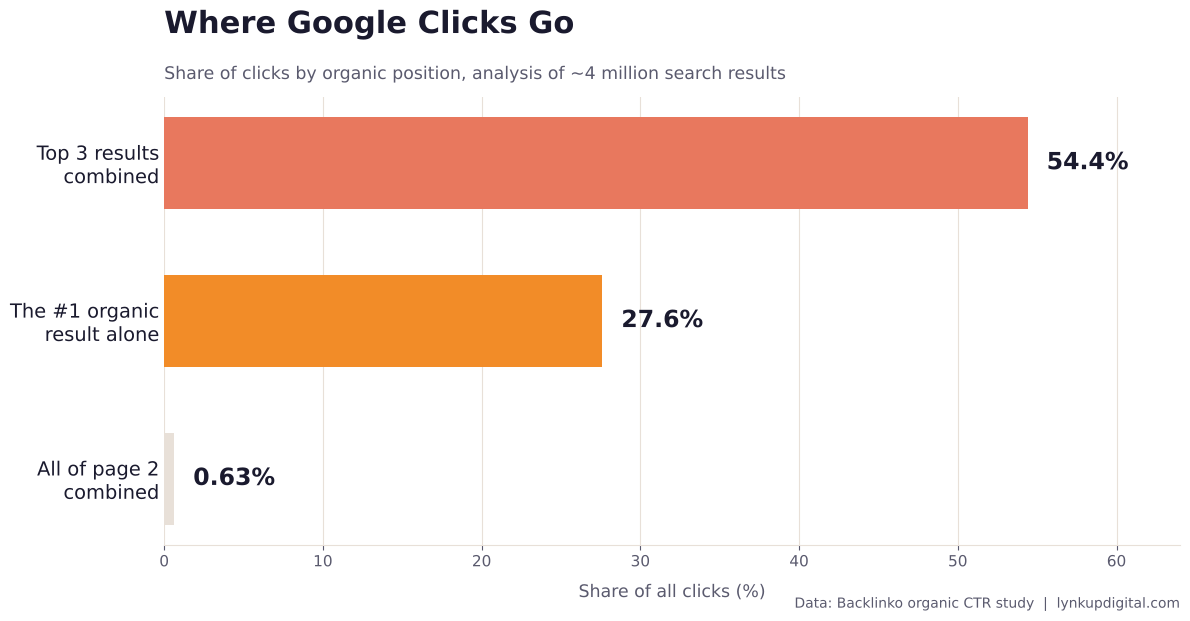
Data: Backlinko organic CTR study of roughly 4 million search results.
2. Protection when the algorithm shifts
Google updates its systems constantly, and several confirmed core updates land every year. Sites that have not been touched in months tend to feel those updates hardest, because thin content, slow pages and outdated information pile up quietly.
A monthly programme spreads the maintenance out. Issues get fixed as they appear, content stays current, and when an update rolls through, your site is already in the shape Google rewards.
3. Content that builds topical authority
One good article rarely ranks on its own. Google favours sites that cover a subject properly, and that depth only comes from publishing and updating month after month.
Ongoing content work also widens your keyword footprint. Each new page is another entry point, and refreshed older pages recover positions they had started to lose. Over a year, that is the difference between ranking for a handful of terms and ranking for hundreds.
4. Technical problems get caught early
Broken links, crawl errors, slow templates, pages accidentally set to noindex: technical faults rarely announce themselves. They quietly drain rankings until someone looks.
With monthly technical SEO checks, faults get found in week one, not month six. That early detection alone can pay for a retainer, because recovering lost rankings takes far longer than preventing the loss in the first place.
5. The gap between you and competitors widens
Your competitors are not pausing. If they publish, earn links and fix their sites every month while yours stands still, they pass you, and search is a winner-takes-most game.
Backlinko’s data shows that moving from position two to position one lifts clicks by 74.5%. Margins that fine are won by whoever keeps working. Consistency is the moat.
6. Stronger local visibility
For UK businesses that serve a town or region, local SEO is where monthly work shows up fastest. Reviews need responses, categories and photos need updating, and location pages need refreshing as your services change.
Your Google Business Profile is a living listing, not a set-and-forget one. Monthly attention keeps you in the map pack when someone nearby searches for what you do.
7. Lower cost per lead than ads, over time
Paid ads stop the moment the budget does. Organic rankings keep sending visitors without a per-click fee, so the longer a campaign runs, the cheaper each lead becomes.
That does not make SEO free. It makes it an asset you are building instead of rent you are paying. Month twelve of a retainer usually produces far more traffic than month one, at the same price.
8. Accountability through monthly reporting
A proper monthly SEO package comes with a report: what was done, what moved, and what is planned next. That rhythm keeps the provider honest and keeps you informed.
It also gives you real data for decisions: which pages convert, which keywords bring buyers rather than browsers, and where next month’s budget should go. If your current provider’s reports are vague, that is a warning sign we cover below.
9. Visibility in AI search, not just blue links
Google now answers many queries with an AI summary at the top of the page, and those summaries quote sources. Pages that are current, well structured and genuinely authoritative are the ones that get cited.
Keeping content in that state is, by definition, ongoing work. A page nobody has edited since 2023 rarely makes the cut.
10. Growth you keep
The quiet benefit of monthly SEO is loss prevention. Rankings decay when work stops: content dates, links break, competitors overtake. A retainer protects the position you have already paid to reach while continuing to add to it, so you compound gains instead of restarting from scratch every time traffic dips.
Monthly SEO vs One-Off SEO: What Is the Difference?
A one-off project and a monthly service solve different problems. The project fixes what is wrong today. The retainer keeps you competitive tomorrow.
|
One-off SEO project |
Monthly SEO service |
|
|
Scope |
Audit and initial fixes |
Continuous optimisation |
|
Content |
Set up once |
Published and refreshed every month |
|
Links |
Rarely included |
Built steadily, month after month |
|
Results curve |
Early bump, then plateau or decline |
Slower start, compounding growth |
|
Algorithm updates |
You absorb them alone |
Strategy adapts as they land |
|
Best for |
New sites needing a foundation |
Businesses competing for rankings long term |
The honest answer is that most businesses need both: a thorough setup, then ongoing work. A foundation with no follow-through fades. Follow-through on a broken foundation wastes money.
What Is Included in a Monthly SEO Service?
Deliverables vary by provider and budget, but a credible monthly SEO package usually covers five areas.
|
Area |
Typical monthly work |
|
Content |
New blog posts or service pages, updates to existing pages |
|
Technical |
Crawl checks, speed fixes, broken links, indexing issues |
|
Link building |
Outreach for genuine placements on relevant websites |
|
Local |
Google Business Profile updates, citations, review responses |
|
Tracking and reporting |
Keyword positions, traffic, conversions, next month’s plan |
Ask any provider to show you last month’s deliverables for a real client. If they cannot, keep looking. At Lynkup Digital, link building means manual outreach to real websites, and every client receives a monthly report listing exactly what was done.
How Much Does Monthly SEO Cost?
According to Ahrefs’ survey of 439 SEO providers, SEO costs typically run from $250 to $10,000 a month, and most businesses (63%) spend between $500 and $5,000. The single most common retainer tier is $501 to $1,000 a month, charged by 20.4% of providers, and 68.8% of providers charge $2,000 or less. For small business work specifically, the same survey found around 42% of providers charge between $250 and $1,000 a month.
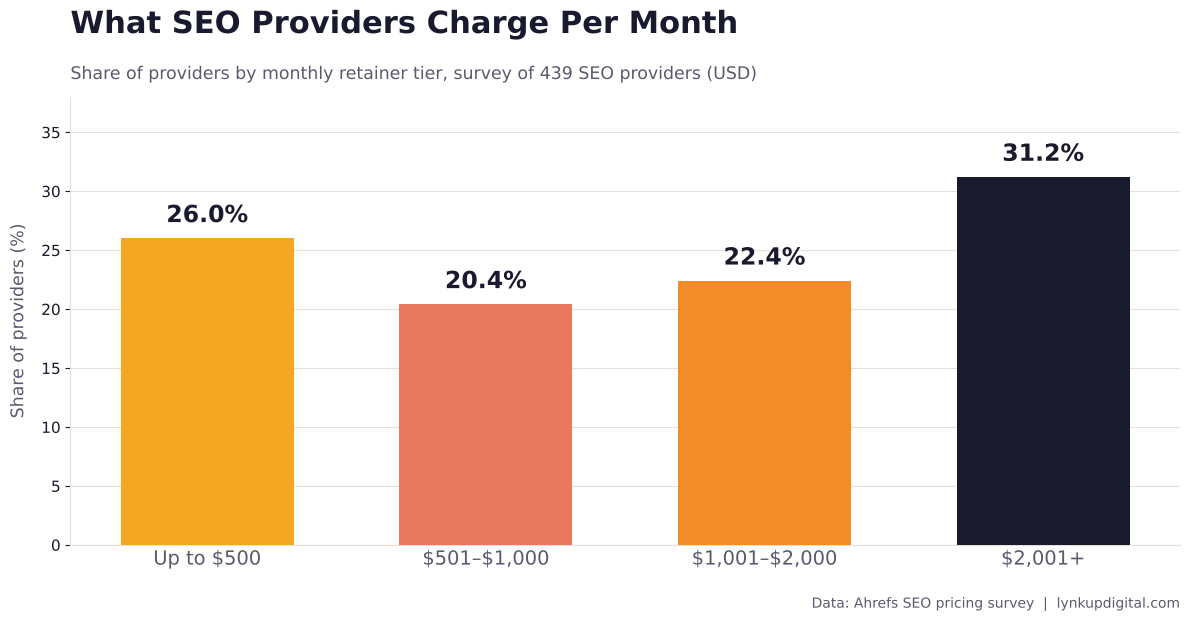
Data: Ahrefs survey of 439 SEO providers. Figures in US dollars.
For UK small businesses, sensible entry points sit at the lower end of those figures. Our own SEO campaigns start from £350 a month, with everything listed openly on our pricing page, and we work month to month with no lock-in contract.
Price should map to deliverables. A few hundred pounds buys a small number of focused hours each month; £2,000 buys a full programme of content, links and technical work. Be suspicious of anyone promising everything at the bottom price.
How Long Until Monthly SEO Shows Results?
Expect early movement, not early victory. In our own campaigns at Lynkup Digital, clients usually see the first movement within 8 to 12 weeks: rankings stirring, impressions climbing, a few keywords entering the top twenty. Meaningful traffic and leads build over the months that follow, because the gains compound.
Three things set the pace. Your starting point, since a new site takes longer than an established one. Your competition, because ranking for a local trade term is quicker than ranking for insurance. And consistency, which is the whole argument for the monthly model. Anyone promising page one in 30 days is selling something other than SEO.
Is Monthly SEO Worth It?
For most businesses that depend on being found online, yes, and the search results themselves make the case: the top three positions take over half of all clicks. But “worth it” depends on your situation and your provider, so here is the honest version.
When a monthly retainer pays for itself
A retainer tends to pay off when:
-
Customers actually search for what you sell, and a lead is worth real money
-
Your market is competitive enough that rankings need defending
-
You can commit for at least six months, because compounding needs runway
-
The provider shows you specific monthly deliverables, not vague “optimisation”
One of our e-commerce clients saw organic traffic grow 65% across three months of consistent monthly link building, with more than 40 placements earned from relevant sites in their niche. That is what compounding looks like when the conditions above are met.
When it is not worth it, and the red flags
Skip or pause a retainer when your website cannot convert traffic yet, when almost nobody searches for your offer, or when the budget would starve more urgent basics, such as a site that works properly on mobile.
And walk away from any provider showing these red flags:
-
Guaranteed rankings. Nobody controls Google, and guarantees usually signal shortcuts.
-
No named deliverables. “We optimised your site” is not a report.
-
Cheap bulk links. Fifty directory links can hurt more than they help.
-
Lock-in contracts with no exit. Confidence does not need a cage.
-
Zero questions about your business. SEO without strategy is motion, not progress.
If you have been paying for months and cannot name one thing your provider did last month, that is your answer.
Is SEO Dead Now That AI Answers Questions?
No, but it has changed shape. Pew Research Center tracked 68,879 real Google searches from 900 US adults and found an AI summary appeared on 18% of them. When a summary showed, users clicked a traditional result on 8% of visits, against 15% without one, and only 1% clicked a source inside the summary itself.
Two things follow. First, with fewer clicks to go round, the clicks that remain concentrate on the strongest results, which makes top positions more valuable, not less. Second, AI summaries are built from pages Google already trusts, so the same signals that win rankings also decide who gets quoted: current content, clean structure, real authority.
Both outcomes reward ongoing work. The sites losing ground are the ones standing still.
Who Benefits Most from Monthly SEO?
Monthly SEO fits some businesses better than others.
-
Local service businesses, from trades to clinics to solicitors, that live and die by “near me” searches
-
E-commerce stores, where every ranked product and category page sells around the clock
-
Service firms chasing high-value keywords, where one new client covers a year of fees
-
Anyone in a competitive niche, because standing still there means going backwards
If you only need a brochure site found for your own brand name, a one-off setup may be enough. Any business competing for non-branded searches benefits from the monthly model.
The Bottom Line
The benefits of monthly SEO all trace back to one idea: search rewards consistency. Compounding traffic, algorithm resilience, topical authority, and now AI visibility are built the same way, a month at a time.
If you would like a plan rather than a pitch, get in touch and we will look at your site together. We work month to month, so we have to earn the next invoice. That is how it should be.