Clutch lists over 2,390 SEO companies for London alone. Every one of them claims to be award-winning, results-driven and trusted by big brands. Prices run from £495 a month to £20,000 a month for what sounds, on the surface, like the same service. Pick wrong and you burn six months of budget before you find out. This guide shows you how to choose an SEO agency in London with a clear head: what the work should include, what it really costs in 2026, and the red flags that show up in the very first sales call.
What Does an SEO Agency in London Actually Do?
A good agency does one thing: it makes your website the answer Google (and now AI assistants) show when your customers search. Everything else is a means to that end.
The core services every retainer should cover
Whatever the price point, a legitimate SEO service should include most of the following:
- Keyword research and strategy. Mapping what your customers actually type into Google, and which pages on your site should win each query.
- Technical SEO. Fixing crawlability, page speed, indexing and site structure. If Google cannot read your site properly, nothing else matters. A technical SEO audit should come first, not as an upsell later.
- On-page optimisation. Titles, headings, internal links and content tuned to the keywords you are targeting.
- Link building. Earning links from real, relevant websites to build your site's authority. This is the part most often faked, which we cover in the red flags section.
- Local SEO. For any business serving a physical area, local SEO and a well-managed Google Business Profile often produce the fastest wins. London is really a cluster of local markets: a plumber in Hackney competes on "plumber Hackney", not "plumber London".
- Reporting. A monthly report that shows what was done, what moved, and what happens next. In plain English, not screenshots of dashboards.
The 2026 addition: AI search visibility
Search no longer means only Google's ten blue links. People now ask ChatGPT, Gemini and Perplexity for recommendations, and Google itself answers many queries with AI Overviews before any organic result appears. Nearly every serious London agency now offers some form of AI search work, often labelled GEO (generative engine optimisation) or AEO (answer engine optimisation).
You do not need a separate "AI SEO" retainer. You do need an agency that structures content, schema and brand mentions so that AI systems can find and cite you. Treat it as a required chapter of modern SEO, not a bolt-on product. If an agency has no answer when you ask how they approach AI search, that tells you how current their playbook is.
How Much Does an SEO Agency Cost in London?
According to Ahrefs' SEO pricing study, which polled 439 SEO providers, the average cost of SEO services is $2,917 per month (roughly £2,300), 78.2% of providers charge a monthly retainer, and agencies charge on average 138% more than freelancers. The most common bracket is smaller: 23% of providers charge between $500 and $1,000 a month.
London sits above the global average. Clutch's London directory shows the typical SEO project in the city landing between $10,000 and $49,000 in total spend, and enterprise programmes go far beyond that.
The three pricing tiers in London
| Tier | Monthly cost | Who it suits | What you typically get |
|---|---|---|---|
| Boutique / budget | £495 to £1,500 | Local and small businesses | 5 to 15 target keywords, on-page fixes, a modest number of links, monthly reporting |
| Mid-market | £1,500 to £4,000 | Growing SMEs, ecommerce | Full technical work, content production, consistent link building, local SEO |
| Enterprise | £4,000 to £20,000+ | National brands, competitive verticals | Dedicated teams, digital PR, international SEO, custom tooling |
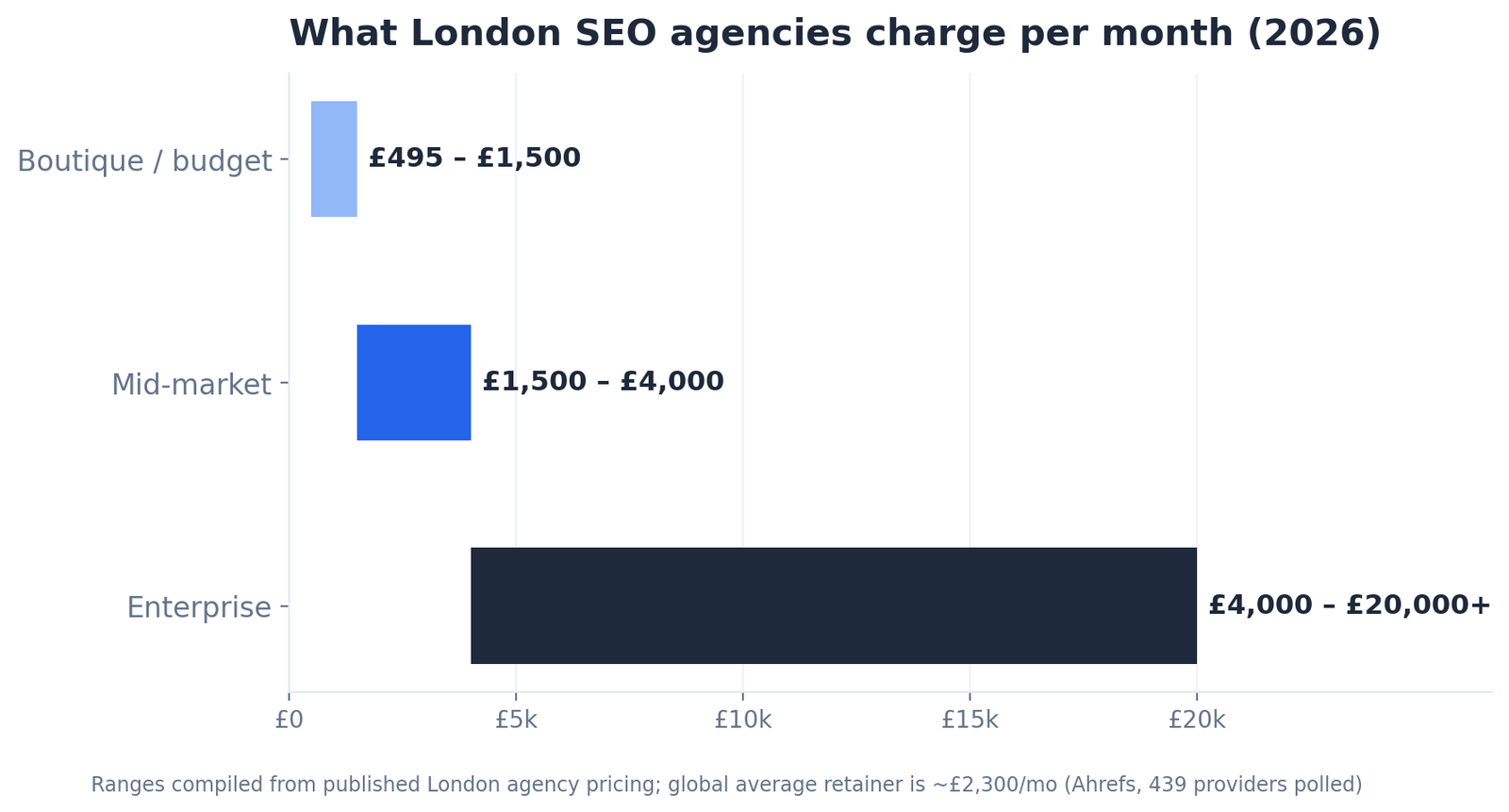
Two things matter more than the number on the invoice. First, whether the deliverables match the tier: a £3,000 retainer that produces two blog posts and a dashboard is worse value than a £700 retainer that fixes your site and builds five real links. Second, the contract terms. Month-to-month pricing, like the plans on our pricing page, keeps the agency accountable every single month. A 12-month lock-in removes that pressure entirely.
Why cheapest is not always worst
The expensive agencies in Mayfair and Clerkenwell are not selling you a different Google. They are selling process, headcount and, often, office rent. For a small business targeting a handful of local keywords, a boutique provider doing hands-on work frequently outperforms an enterprise agency that assigns you a junior account manager. Judge output, not postcode.
Agency vs In-House vs Freelance Consultant
Three ways to buy the same skill set, each with a different trade-off:
- In-house SEO. Full control and full context on your business, but a mid-level London SEO hire costs £40,000 to £60,000 a year plus tools, and one person cannot cover technical, content, links and AI search equally well.
- Freelancer or SEO consultant. Ahrefs' data shows freelancers charge substantially less than agencies for comparable work. Ideal for audits, strategy and smaller sites. The risk is capacity: one person, one calendar.
- Agency. A team covering every discipline, at a premium. Best when you need sustained execution, not just advice.
For most London small businesses, the practical answer is a small agency or consultant on a monthly retainer: enough hands to execute, small enough that the founder still knows your account.
7 Red Flags When Hiring an SEO Agency
These show up in the first call or the first proposal. Any one of them is a reason to slow down. Two or more is a reason to walk away.
- Guaranteed rankings. Nobody controls Google. Google's own documentation states plainly that no one can guarantee a #1 ranking. An agency promising "page one in 30 days" is either lying or planning shortcuts that get you penalised.
- Long lock-in contracts. SEO takes months, but that is an argument for realistic expectations, not for a contract you cannot exit. Agencies confident in their work let results do the retaining.
- Bulk link packages. "150 backlinks per month" means directory spam, PBNs or paid placements on junk sites. Google's spam policies treat link schemes as a violation that can tank your rankings. Real link building means manual outreach to relevant sites, and it produces links in the tens, not the hundreds.
- No named point of contact. If the sales call is the last time you speak to a senior person, expect ticket-queue service afterwards.
- Vague reporting. Ask to see a sample monthly report before signing. If it is all impressions and "visibility scores" with no list of work completed, you will never know what you are paying for.
- A template strategy. If the proposal could apply to any business in any industry, it was not written for you. A real proposal names your actual keywords, your actual competitors and your site's actual problems.
- They will not explain what they do. "Proprietary methods" is a phrase that protects the agency, not you. Legitimate SEO has no secrets, only execution.
10 Questions to Ask Before Signing
Take these into every sales call. The answers separate operators from salespeople.
- Who will actually work on my account, and can I speak to them?
- What does your link building process look like, site by site?
- Can I see a sample monthly report?
- What results have you achieved for a business like mine? Show me the data.
- What happens in the first 30, 60 and 90 days?
- How do you handle Google algorithm updates?
- What is your approach to AI search visibility (ChatGPT, Gemini, AI Overviews)?
- What are the contract terms, and what does cancelling look like?
- Which parts of the work will need input or approval from my side?
- What would make you tell me SEO is the wrong investment for my business right now?
That last question is the most revealing. An honest agency will name scenarios where paid ads or a website rebuild should come first. A sales-driven one will insist SEO fits everyone.
How Long Before SEO Results Show?
For most small business campaigns, expect early movement within 8 to 12 weeks and meaningful results within 4 to 6 months. Local campaigns in low-competition niches move faster. Competitive national keywords take longer.
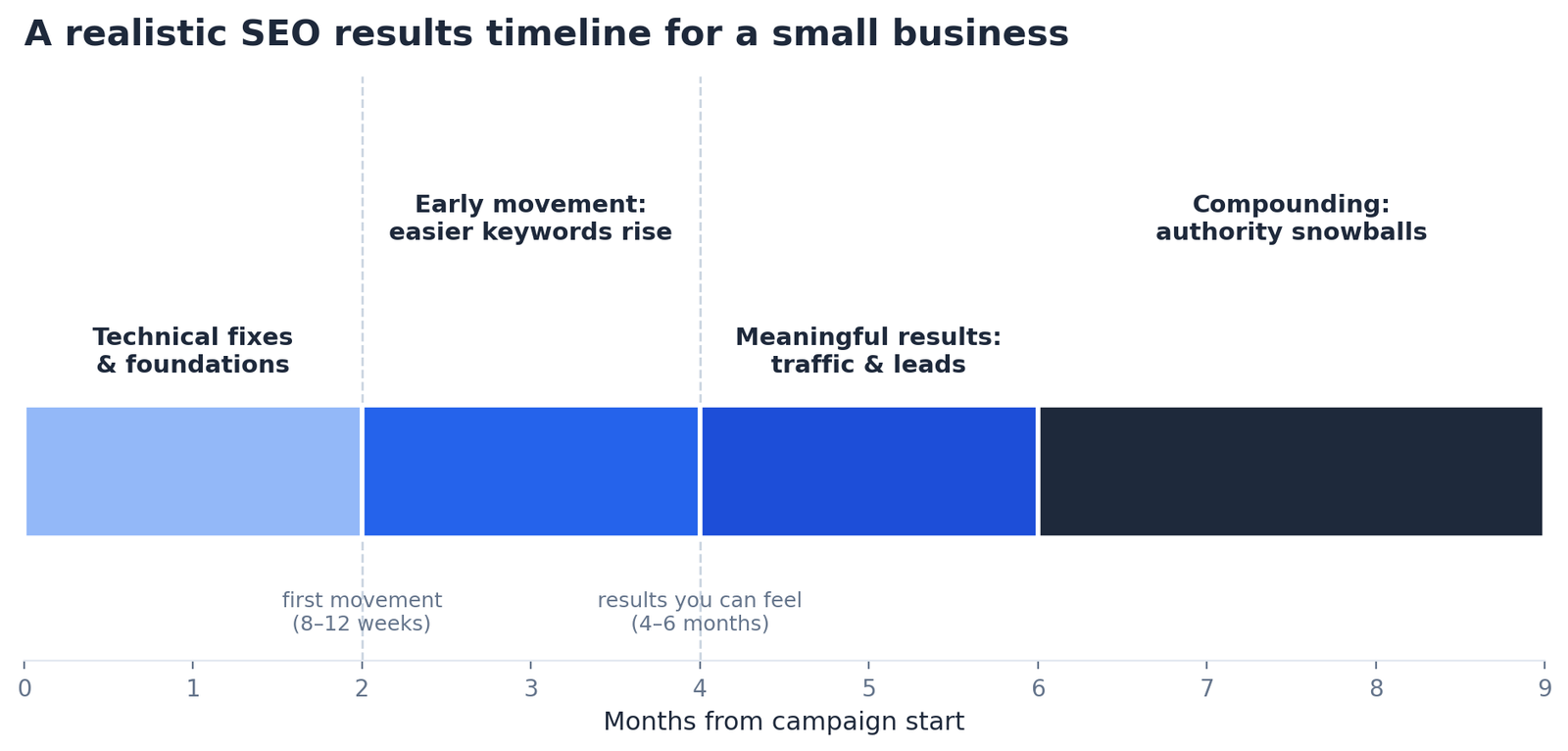
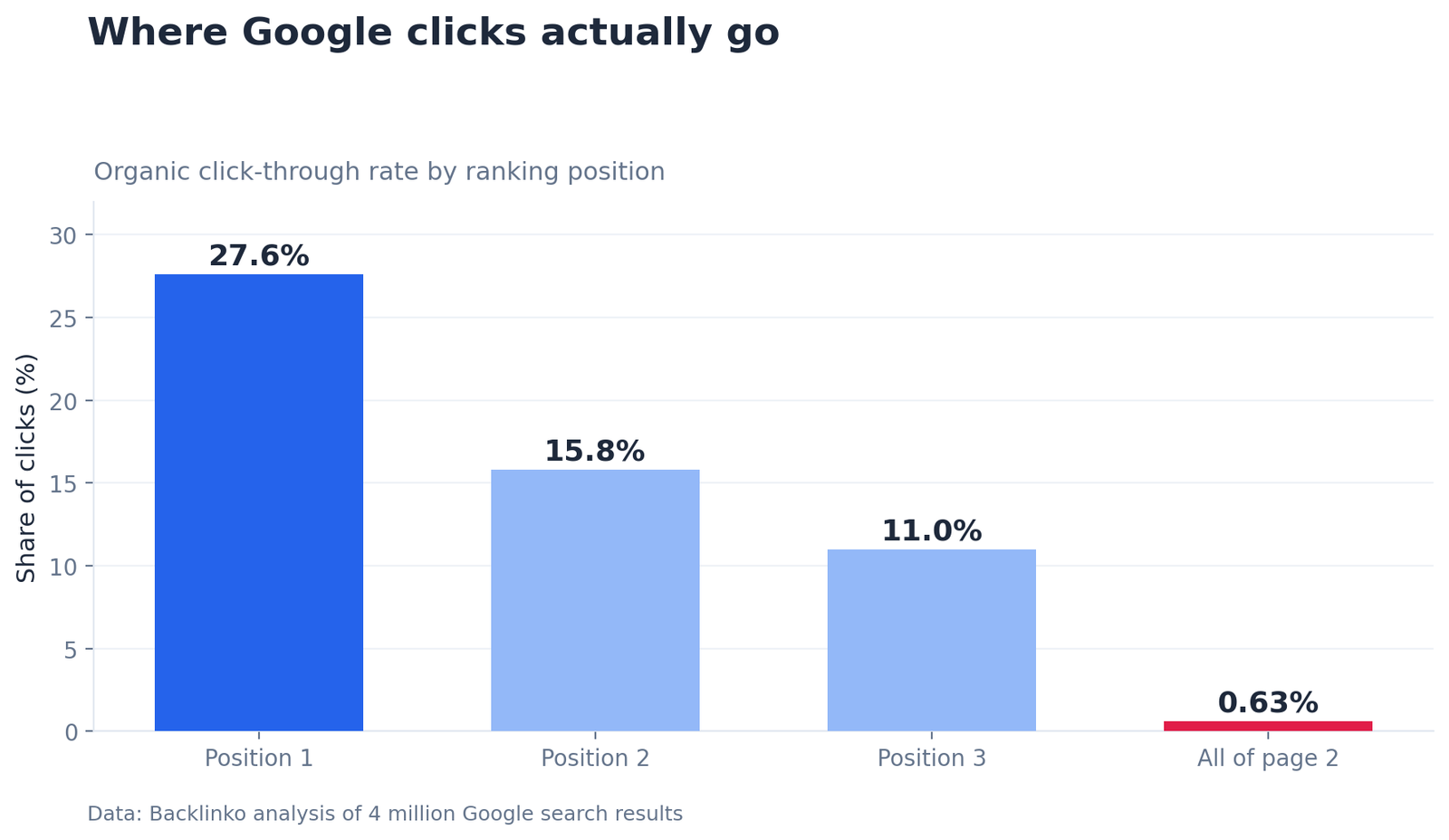
The reason patience pays is simple maths. Backlinko's analysis of 4 million Google search results found the #1 result earns a 27.6% click-through rate, while only 0.63% of searchers click anything on page two. The traffic difference between position 8 and position 2 is not incremental. It is the difference between invisible and busy. Compounding link authority and content depth are what move you up that curve, and both accrue month over month.
Be wary of any provider who reframes slow results as "SEO just takes time" without showing interim progress. Rankings for easier keywords, growing impressions in Search Console and completed technical fixes should all be visible well before revenue moves.